
Advice
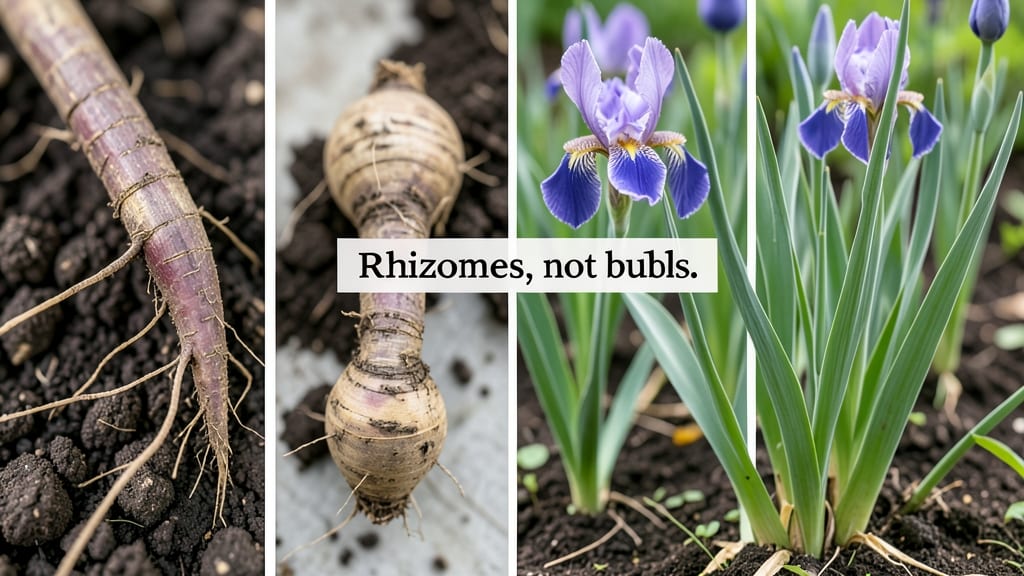
Irises don't have bulbs—they grow from thick, fleshy rhizomes that spread horizontally just below the soil surface. These rhizomes store nutrients for regrowth each season and require careful handling during division.
This might surprise gardeners used to plants like tulips or daffodils, but irises rely on these horizontal root structures instead of true bulbs. 🌱 The rhizomes act like underground storage units, packing away energy for next year's blooms while their segmented, gnarled appearance sets them apart from smooth bulb shapes.
Unlike bulbs that grow vertically, iris rhizomes spread outward, which is why they need proper spacing when planted.
One key advantage of rhizomes is their hardiness—they tolerate a wide range of conditions better than many bulbous plants. However, their placement matters: burying them too deep suffocates the plant, while exposing them too much leads to drying out.
I've learned the hard way that patience during division pays off, as forcing an iris to bloom too early can exhaust its energy stores.
💡 In This Article
- How Iris Rhizomes Differ From Bulbs
- Caring for Iris Rhizomes: Planting and Maintenance Tips
How iris rhizomes differ from bulbs
Iris rhizomes are fundamentally different from traditional bulbs like tulips or onions. While bulbs store nutrients in concentric layers (like an onion), iris rhizomes grow horizontally as thick, segmented roots—typically 2-4 inches long and ½-1 inch thick.
These rhizomes have a rough, gnarled texture with visible growth points called "eyes" where new shoots emerge. The surface often appears scaly or slightly leathery, unlike the smooth, papery covering of bulbs.
The key difference lies in their growth pattern: bulbs grow vertically downward, while iris rhizomes spread outward along the soil surface. This horizontal growth allows irises to form dense clumps over time, which is why gardeners often divide them every 3-5 years to prevent overcrowding.
The rhizome's thick, fleshy structure stores starches and sugars—similar to how bulbs function—but its segmented shape makes it more resilient to temperature fluctuations and drought conditions.
Botanically, iris rhizomes belong to a category called "corms" or "rhizomatous roots," which are specialized for perennials. Unlike bulbs that decompose after flowering, iris rhizomes persist year after year, sending up new foliage from the same growth points.
This is why you'll often see iris plants with multiple fans of leaves emerging from a single clump—each fan represents a new growth cycle supported by the rhizome's stored nutrients.
One visual clue to identify iris rhizomes is their positioning: they sit just below the soil surface, typically exposed when planted correctly. Unlike bulbs that should be buried, iris rhizomes should only have their top ⅓ covered with soil.
The exposed portion helps prevent rot while allowing the plant to absorb sunlight for photosynthesis. This unique adaptation explains why irises thrive in sunny, well-drained locations where other bulbous plants might struggle.
Comparing iris rhizomes to true bulbs reveals another crucial difference: their regenerative capacity. When divided properly, each segment of an iris rhizome can regrow into a new plant, whereas bulbs must be planted whole.
This makes iris rhizomes incredibly hardy—even damaged segments often survive if they contain viable growth points. The trade-off? Their horizontal spread means they require more space than bulbous plants in containers or small gardens.
For gardeners transitioning from bulbs to irises, the biggest adjustment is learning to work with this horizontal growth habit. While bulbs can be planted densely, iris rhizomes need 12-18 inches of spacing between clumps to prevent competition.
This spacing also allows for better airflow, reducing the risk of fungal diseases that thrive in crowded, moist conditions. The rhizome's segmented structure makes it particularly vulnerable to rot if planted too deeply, which is why proper depth is critical.